Ashura-inspired marquetry work donated to Shah Abdol-Azim Museum
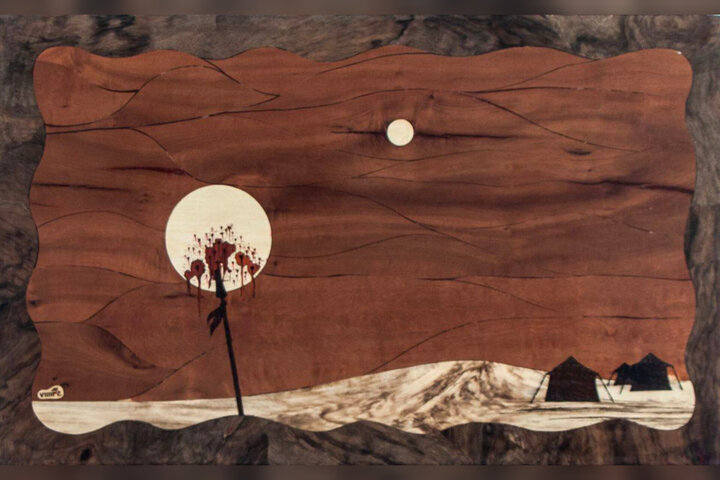
TEHRAN- Iranian marquetry artist Hamed Asgarian has donated his conceptual artwork “Blood of God,” inspired by the tragedy of Ashura, to the museum of the holy shrine of Shah Abdol-Azim al-Hasani (AS) in Rey.
The artwork was donated during Asgarian’s exhibition “Marquetry … A Different Kind,” which was held at the Rayzan International Conference Center on September 28 and 29, Mehr reported.
The exhibition featured a collection of Asgarian’s works that bring together natural wood, geometry, nature and cultural narratives, presenting marquetry from a contemporary perspective.
One of the main events of the exhibition’s opening was the presentation of “Blood of God” to the museum of the holy shrine of Shah Abdol-Azim al-Hasani (AS). The ceremony was attended by Ali Ansarian, director general of cultural affairs at the holy shrine, and Mehdi Barari, head of its museum.
Created in August 2022, “Blood of God” measures 74 by 53 centimeters and weighs 4.75 kilograms. The conceptual work is made of natural, dried wood, which has been left untreated and free of additional ornamentation to preserve the material’s natural texture and character.
The work draws on the events of Ashura and the martyrdom of Imam Hussein (AS). Its visual composition combines contrasting areas of light and darkness with elements representing earth and sky, while two luminous circles evoke the symbolic imagery of Karbala.
The description accompanying the artwork refers to Imam Hussein (AS) as “the blood of God” and recalls the moment when his head was raised on a spear, likening the scene to the appearance of two suns in the blood-stained sky of Karbala.
By donating “Blood of God” to the museum, Asgarian has placed a contemporary work inspired by one of the most enduring narratives of Iranian religious and cultural memory within a permanent museum collection. The work can now form part of the institution’s visual record of contemporary artistic interpretations of Ashura.
Asgarian, who holds degrees in mechanical engineering and operations research, has combined his engineering background with years of experience in marquetry. His artistic practice has resulted in a distinctive approach known as “Chiltechini.”
In works based on this style, geometry serves as more than a decorative element and functions as a structural principle. Repeated hexagonal forms are combined with pieces of wood that retain their natural textures, creating a visual balance between geometric precision and the organic qualities of nature.
Curated by Sara Golestani and with Mona Fahmideh as artistic director, the exhibition aimed to move marquetry beyond its conventional association with handicrafts and traditional decoration and explore its possibilities as a contemporary art form.
Asgarian has previously exhibited his works in countries including the Netherlands, Türkiye, Costa Rica, Oman and Spain. His work “Family” received attention at an international competition in Costa Rica, while “Tavaf-e Del” (Heart’s Circumambulation) has been registered in the collection of Iran’s National Library and Archives.
Ashura refers to the tenth day of Muharram, the first month of the Islamic calendar, and marks one of the most significant events in Islamic history: the martyrdom of Imam Hussein (AS), the grandson of Prophet Muhammad (PBUH). In 680 CE, Imam Hussein led a small group of family members and companions against the massive army of Yazid I, the Umayyad caliph, at the plains of Karbala in present-day Iraq. This clash was not merely a political struggle for power, but a profound moral stand against tyranny and injustice. Despite being outnumbered and denied access to water for days, Imam Hussein and his followers remained steadfast in their principles until their eventual martyrdom.
The legacy of Ashura transcends time and geography, serving as a universal symbol of the struggle between truth and falsehood. For millions of people worldwide, Imam Hussein is revered as the "Prince of Martyrs" and a timeless icon of courage, sacrifice, and integrity. His refusal to pledge allegiance to a corrupt ruler, even at the cost of his own life and the lives of his loved ones, continues to inspire movements for liberation and human rights. Today, Ashura is commemorated through mourning rituals, processions, and reflections on the enduring victory of the oppressed over the oppressor.
SAB/
Leave a Comment